
 352-639-5270




AI and search engine optimization are now the same conversation. Learn how to structure your content for AI Overviews, ChatGPT, and Perplexity — plus the technical foundations to stay visible.
AI and search engine optimization are no longer two separate conversations — they're the same one.
Here's the quick version of what you need to know:
How to win at AI search engine optimization:
- Make your content easy to extract — use clear headings, short paragraphs, and direct answers
- Use structured data (schema markup) — help AI systems understand who you are and what you do
- Allow AI crawlers access — check your robots.txt isn't blocking GPTBot or similar bots
- Build topical authority — cover your subject thoroughly, not just a few keywords
- Keep content fresh — AI systems favor recently updated pages
- Optimize for citations, not just clicks — your goal is to be referenced in AI-generated answers
Now for the bigger picture.
Google processes 354 million searches every hour. That number isn't slowing down — but how those searches get answered is changing fast.
As of early 2025, Google's AI Overviews appear in roughly 13% of all searches. That figure nearly doubled in just two months. About half of all US Google searches already end without a single click — meaning users got their answer right on the results page, without ever visiting a website.
For a small business counting on organic traffic for leads, that's a problem if you're not prepared. But it's an opportunity if you are.
The businesses showing up inside AI-generated answers aren't just the biggest brands. They're the ones whose content is structured, clear, and built to be understood — not just indexed.
That's what this guide is about.
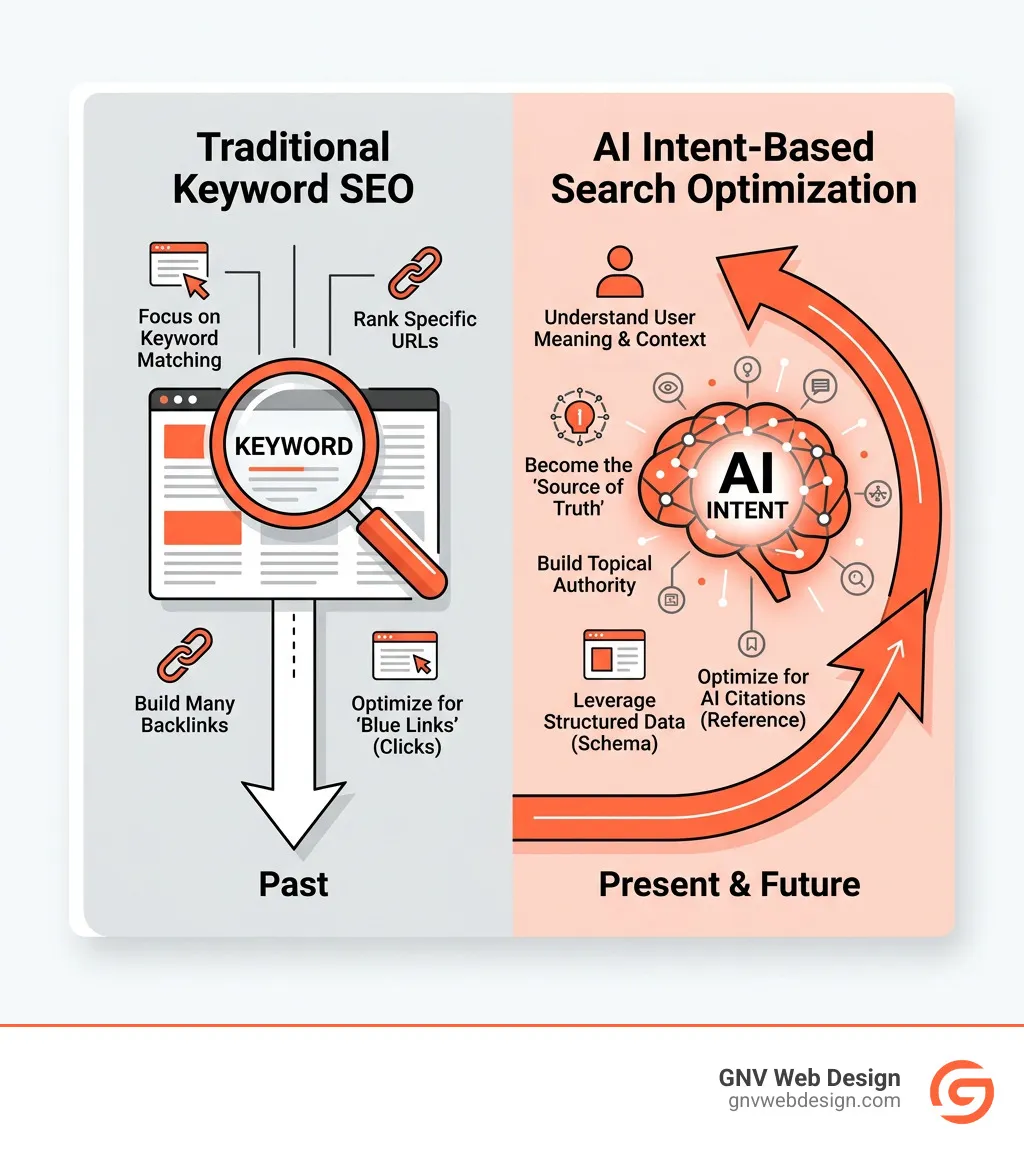
Understanding AI and Search Engine Optimization
To understand where we are going, we have to look at where we've been. Traditional SEO was largely about "matching." You chose a keyword, placed it in your title tag, and hoped Google's crawlers saw the connection. But as we move deeper into the era of ai and search engine optimization, the game has shifted from matching words to understanding meaning.
Traditional SEO focuses on ranking a specific URL in a list of blue links. AI SEO, however, is about becoming the "source of truth" that an AI model uses to construct an answer. Whether it's ChatGPT, Perplexity, or Google's AI Overviews, these systems don't just want to show a link; they want to synthesize information.

Google has been preparing for this for years through a series of massive algorithm updates:
- RankBrain (2015): The first major step into machine learning, helping Google interpret queries it had never seen before by connecting them to similar concepts. RankBrain now processes over 15% of daily searches.
- BERT (2019): This allowed Google to understand the context of words in a sentence rather than just looking at them individually.
- MUM (2021): The Multitask Unified Model is 1,000 times more powerful than BERT. It can understand information across 75 different languages and multiple formats (like images and text) simultaneously. Learn more about Google's MUM.
For those just starting, it's helpful to revisit the basics of how to do SEO for beginners to see how these fundamentals provide the bedrock for AI success.
The Evolution of AI and Search Engine Optimization
We are witnessing a transition from "keyword strings" to "entities." In the past, search engines saw "best pizza Gainesville" as three separate words. Today, thanks to natural language processing, they see "Gainesville" as a geographic entity and "pizza" as a culinary entity.
This shift toward semantic search means that AI models are looking for intent. When a user asks a conversational question, the AI looks for content that provides a direct, authoritative answer. It's no longer enough to mention a keyword; you must demonstrate deep topical knowledge and clear relationships between concepts.
Why Generative Engine Optimization (GEO) is the New Standard
If SEO is for search engines, GEO (Generative Engine Optimization) is for "Answer Engines." This is a subset of ai and search engine optimization specifically designed to make your content citable by Large Language Models (LLMs).
Recent scientific research on GEO from researchers at Princeton and Georgia Tech suggests that specific strategies—like adding statistics and direct quotations—can increase your visibility in AI responses by up to 40%. The goal of GEO isn't just to rank #1; it's to be the brand that the AI chooses to mention when it explains a topic to a user. This is often called "information gain"—providing unique value that isn't just a carbon copy of what everyone else is saying.
Core Strategies for AI Search Visibility
Winning in the AI era requires a blend of technical precision and high-quality storytelling. We often tell our clients in Gainesville and Tampa that their website needs to be as readable for a robot as it is for a human.
One of the most powerful ways to do this is through structured data. Think of schema markup as a "cheat sheet" for AI. It tells the search engine exactly what a piece of data is—whether it's a price, a review score, or an author's credentials. Google recommends including all relevant properties in your schema to improve your chances of appearing in rich results.
If you are wondering how this fits into the broader picture, check out our guide on what are the 4 types of SEO to see where technical and on-page optimization meet.
Technical Foundations for AI and Search Engine Optimization
Your technical setup can either open the door for AI or slam it shut. Many businesses are unintentionally blocking the very bots they want to attract.
- Check your robots.txt: Ensure you aren't blocking agents like GPTBot (OpenAI), OAI-SearchBot (real-time search), or Google-Extended.
- The llms.txt file: A new emerging standard is the
llms.txtfile, which provides a simplified version of your site's content specifically for AI models to digest. - Speed and Rendering: JavaScript-heavy websites can be difficult for some AI crawlers to "read" if they aren't rendered correctly on the server side. Aim for a Largest Contentful Paint (LCP) of under 2.5 seconds.
For more technical tips, our web development SEO best practices cheat sheet offers a deep dive into building a site that search engines love.
Content Optimization and the Island Test
A key concept in GEO is the Island Test. This means that every paragraph or section of your content should be able to stand alone as a "self-contained" island of information. Why? Because AI models "chunk" your content into small pieces to store them in a RAG (Retrieval-Augmented Generation) pipeline.
If a paragraph says, "It is the best choice because of the reasons mentioned above," it fails the Island Test. The AI doesn't know what "It" is or what the "reasons" were if it only retrieves that one chunk. Instead, use clear entities: "GNV Web Design's SEO plan is the best choice for Gainesville small businesses because it prioritizes technical health and local visibility."
| Feature | Traditional SEO | Generative Engine Optimization (GEO) |
|---|---|---|
| Primary Goal | Rank in top 10 blue links | Be cited in AI-generated answers |
| Key Metric | Click-Through Rate (CTR) | Citation Frequency & Share of Model |
| Content Focus | Keyword density & backlinks | Entity clarity & information gain |
| Structure | Standard HTML headings | Markdown tables, lists, & direct answers |
Navigating the Zero-Click Reality and AI Overviews
The rise of AI has accelerated the "zero-click" trend. According to a 2024 study by Rand Fishkin of SparkToro, over 58% of Google searches in the US end without a click.
Google's SGE (Search Generative Experience) and AI Overviews are designed to give users the answer immediately. While this might sound scary for traffic, it's actually a shift in how we measure value. If an AI summary recommends your business as the "best web designer in Gainesville," you might not get a click to your blog post, but you might get a direct phone call or a branded search later.
To ensure your site is ready for this new landscape, follow our ultimate guide to SEO small business website.
Measuring Success Beyond Traditional Rankings
In ai and search engine optimization, we have to look past the "Position 1" metric. Success now looks like:
- Citation Frequency: How often is your brand mentioned in ChatGPT or Perplexity responses?
- Share of Model: What percentage of queries in your niche result in a mention of your brand?
- Sentiment: Is the AI describing your brand positively or neutrally?
- Visibility in AI Overviews: These features are nearly doubling from 6.49% in January 2025 to over 13% by March, showing that presence here is becoming the new "Page One."
Essential Tools and Future Trends for 2025
You don't have to do this alone. There is a massive suite of tools designed to help you master ai and search engine optimization. Interestingly, 17% of marketers save over 10 hours weekly by using AI to automate tedious tasks like meta-description generation and site audits.
- SEMrush & Ahrefs: These giants now offer "AI Overview" tracking, so you can see which of your keywords are triggering AI summaries.
- ChatGPT & Perplexity: Use these as research assistants. Ask them, "Who are the top experts in Gainesville SEO?" If you aren't on that list, ask the AI why and what sources it is using to form that opinion.
- Hosting Matters: Performance is a ranking factor. Check out the best SEO-friendly hosting services for 2025 to ensure your site loads fast enough for AI crawlers.
Avoiding Common AI SEO Pitfalls
The biggest mistake we see is "set it and forget it."
- Blocking the Bots: As mentioned, accidentally blocking GPTBot in your
robots.txtis the fastest way to become invisible to 800 million ChatGPT users. - Over-focusing on Keywords: If your content reads like a list of keywords, AI models will likely flag it as low-quality. Focus on "Entity Clarity."
- Ghost Entities: If search engines can't verify who you are (no "About" page, no social links, no schema), you become a "ghost entity" that AI won't trust to cite.
- Logic Gaps: Ensure your content is factually consistent. AI models look for "triangulation"—if you say one thing on your site and another on your LinkedIn, the AI may find you unreliable.
Using a tool like Screaming Frog can help you find these technical gaps before the AI bots do.
Frequently Asked Questions about AI SEO
Will AI replace SEO in the next 10 years?
The short answer is no, but it will fundamentally transform it. People will always need to find information, products, and services. Whether they use a search bar, a voice assistant, or a chat interface, there is still a "retrieval" process happening in the background. Will SEO exist in 5 or 10 years? Yes, but it will be less about gaming an algorithm and more about being the most authoritative, helpful answer in your niche.
What is the difference between SEO and AIO?
AIO (Artificial Intelligence Optimization) is a broader term that encompasses SEO. While SEO is specific to search engines, AIO focuses on being the "answer" across all AI platforms. This includes brand answering—ensuring that when someone asks an AI assistant for a recommendation, your brand is the one it suggests. You can learn more about the basic mechanics in our FAQ: what is SEO and how does it work.
How do I optimize my site for ChatGPT and Perplexity?
First, ensure your site is indexed by Bing, as ChatGPT often uses Bing for its real-time web searches. Second, use Markdown formatting (like tables and clear H2/H3 headers) because LLMs find this structure very easy to parse. Finally, build "Authority Signals" by getting mentioned in reputable third-party sources like local news or industry journals. For a technical deep dive, see How OpenAI Crawls and Indexes Your Website.
Conclusion
At GNV Web Design, we believe that the future of the web is built on trust and technical excellence. We help small businesses in Gainesville, Tampa Bay, and across Florida grow their revenue by navigating these complex shifts in ai and search engine optimization.
We don't just build websites; we build high-performance growth engines. Our technical-first approach ensures that your site is engineered for SEO from the very first line of code. Whether it's through our ongoing monthly SEO plans, detailed content strategy, or transparent reporting via real-time dashboards, we give you the tools to own your digital future.
The "blue links" of the past are fading, but the opportunity to be the definitive answer in your industry has never been greater. If you're ready to stop chasing algorithm updates and start building a brand that AI search engines can't ignore, we're here to help.

