
 352-639-5270



Local SEO optimization is the fastest path to more customers from search. This step-by-step guide covers Google Business Profile, NAP consistency, reviews, citations, and on-page tactics to dominate your local market.
Local SEO optimization is the process of improving your business's visibility in location-based search results on Google, Google Maps, and other search engines — so nearby customers find you before they find your competitors.
Here's what it covers at a glance:
- Google Business Profile — claim, verify, and fully optimize your listing
- NAP consistency — your Name, Address, and Phone must match everywhere online
- Local citations — get listed in trusted directories like Yelp, Bing Places, and BBB
- Reviews — earn and respond to them consistently
- On-page SEO — location pages, local keywords, and schema markup
- Local links — backlinks from community sites, chambers of commerce, and local press
Here's the reality: 46% of all Google searches have local intent. That means nearly half of everyone searching right now is looking for something near them — a plumber, a dentist, a restaurant, a consultant.
And the window to capture that customer is tiny. Research shows that 50% of smartphone users who do a local search visit a business within a day.
If your business isn't showing up in the local map pack or the top organic results, those customers are walking into your competitor's door — not yours.
The frustrating part? Most small business owners either don't know where to start, or they've paid an agency that built them a beautiful website that generates zero local traffic. Local SEO isn't complicated, but it does require doing the right things consistently.
This guide breaks it all down — step by step, no fluff.
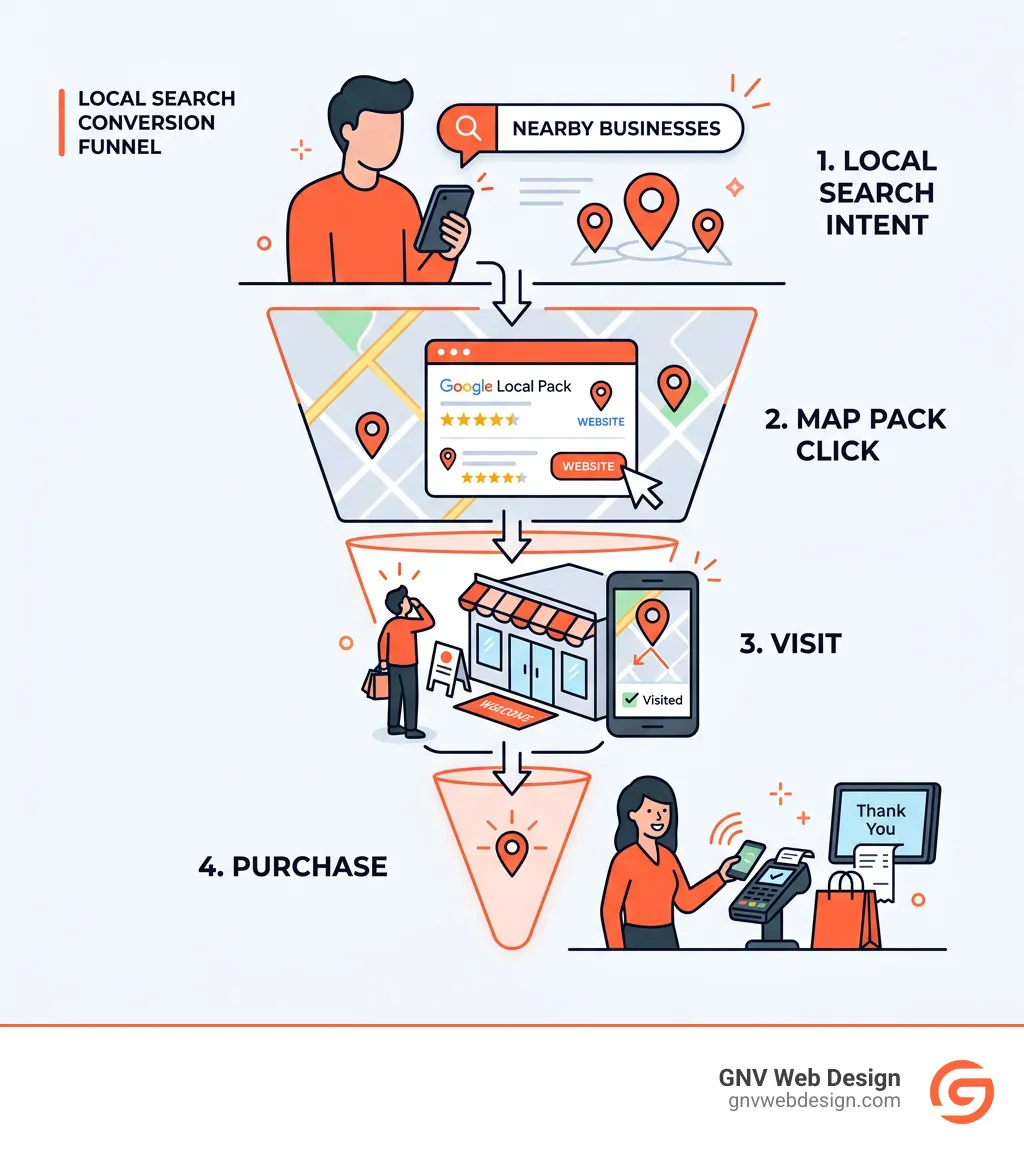
Understanding Local SEO Optimization and How It Works
To win at local search, we first have to understand how Google decides who gets that coveted top spot. When someone searches for a "plumber in Gainesville" or "best coffee near me," Google's local algorithm kicks into high gear. Unlike traditional SEO, which focuses on authority across the entire web, local search is hyper-focused on the user's immediate surroundings.
According to Google's local ranking criteria, there are three primary factors that determine your rank:
- Relevance: How well does your local business profile match what someone is searching for? If you're a dentist but your profile is vague, Google might not show you for "emergency tooth extraction."
- Distance: This is the only factor we can't fully control. Google calculates how far each potential search result is from the location terms used in a search or the user's GPS coordinates.
- Prominence: This is how well-known your business is. Google looks at your offline reputation, the number of reviews you have, your star rating, and how many other websites link to you.
Local Pack vs. Local Organic Results
It is important to distinguish between the two types of results you see on a search page. If you've ever wondered what is SEO and how does it work?, the answer depends on where you want to appear.
| Feature | Local Pack (Map Pack) | Local Organic Results |
|---|---|---|
| Location | Appears at the very top, often with a map. | Appears below the Map Pack. |
| Primary Driver | Google Business Profile (GBP). | Website content and backlinks. |
| Key Factors | Proximity, Reviews, GBP Completeness. | On-page SEO, Domain Authority. |
| Goal | Drive calls and direction requests. | Drive website traffic and information. |
The Core Pillars of Local SEO Optimization
We like to think of local seo optimization as a tripod. If one leg is missing, the whole thing falls over.
- Google Business Profile (GBP): This is your most important asset. It's the "mini-website" that lives on Google Maps.
- NAP Consistency: This stands for Name, Address, and Phone number. If your business is listed as "Gainesville Pizza" on Yelp but "Gainesville Pizza Co." on Google, the algorithm gets confused. Confusion leads to lower rankings.
- Local Citations: These are mentions of your business on other websites (like the Chamber of Commerce or Yellow Pages). They act as "votes of confidence" for your physical location.
Many business owners ask, is doing local SEO worth it? Given that billions of local search results are delivered every month, the answer is a resounding yes. It's often the difference between a phone that rings all day and a quiet office.
Local Keyword Research and Intent
Keyword research for local businesses is slightly different than for a national blog. We aren't just looking for high volume; we are looking for high intent.
- "Near Me" Queries: These have exploded by over 500% in recent years. Users expect Google to know where they are.
- Service-Area Keywords: These include your city or neighborhood name (e.g., "AC repair Tampa Bay").
- Implicit Intent: If you search for "pizza" while standing in downtown Gainesville, Google knows you want a restaurant nearby, even if you didn't type the city name.
Using tools like Google Keyword Planner helps us identify what people are actually typing into that search bar. For more specific tactics, check out our deep dive on Gainesville SEO Strategies.
Mastering Your Google Business Profile (GBP)
Your Google Business Profile is the foundation of your local presence. If you don't have one, or if it's only half-filled, you're invisible to a massive chunk of your market.
To get started, go to business.google.com to claim and verify your business. Once verified, you need to treat this profile like a high-end storefront.
Pro Tip: Profiles with 100 or more images get 1065% more website clicks and 520% more phone calls. Don't just post one photo of your building; post photos of your team, your work, and your happy customers.
When setting up your profile:
- Select the right Primary Category: This is the most weighted factor. If you are a "Family Dentist," don't just put "Doctor."
- Use Secondary Categories: These help you show up for a wider range of services.
- Write a compelling description: Mention what makes you unique and include your main service areas.
This is especially vital for service-based businesses that don't have a traditional retail shop. We've written extensively about unlocking SEO potential for service-based businesses to help you navigate these specific challenges.
Strategies for Local SEO Optimization through Reviews
Reviews are the "social proof" that Google uses to gauge your prominence. Did you know that 95% of customers read online reviews before making a purchase?
Google cares about three things regarding reviews:
- Velocity: How often are you getting new reviews? A business with 10 reviews from last week looks more "alive" than one with 100 reviews from three years ago.
- Diversity: Are you getting reviews on Google, Facebook, and industry-specific sites?
- Response Rate: According to surveys from GatherUp, 92% of consumers consider a business owner's response to be a sign of high-quality service.
If you're wondering how to do SEO for small business, start by asking every happy customer for a review the moment the job is done.
Leveraging GBP Features for Engagement
Don't let your profile sit stagnant. Use these features to stay ahead:
- Google Posts: Think of these as "mini-ads." Share updates, offers, and events.
- Q&A Section: You can actually populate this yourself! Post common questions and provide the official answers so customers don't have to guess.
- Booking Links: If you use a scheduling tool, link it directly to your GBP so customers can book an appointment without even visiting your website.
On-Page and Technical Local SEO Tactics
While your GBP gets you into the Map Pack, your website is what helps you dominate the organic results below it. We build high-performance websites that are engineered for local seo optimization from day one.
One of the most powerful technical tools at our disposal is LocalBusiness Schema markup. This is a piece of code you add to your site that tells Google exactly what your business is, where you are, and what your hours are. It's like giving Google a digital business card that it can read perfectly. You can test your code using Google's Rich Results Test to ensure it's working.
Localized Content and Landing Pages
If you serve multiple cities—say, Gainesville, Tampa Bay, and Ocala—you shouldn't just have one "Services" page. You need dedicated location landing pages. Each page should have:
- Unique content about that specific area.
- An embedded Google Map of your location (or service area).
- Testimonials from customers in that specific city.
For a deeper look at how to structure these, see our Ultimate Guide to SEO Small Business Website.
Building Authority with Citations and Local Links
Citations are any mention of your business name, address, and phone number on the web. We recommend starting with a "NAP Audit." Search for your business and see if there are old phone numbers or wrong addresses floating around. Tools like Semrush's Listing Management can help you find and fix these errors quickly.
Beyond directories, you need local links. These are harder for big national brands to get, which gives you a home-field advantage.
- Chamber of Commerce: A link from your local Chamber is a massive trust signal.
- Local Sponsorships: Sponsoring a Little League team or a local 5k often earns you a link from their "Sponsors" page.
- Local Press: Getting featured in a neighborhood blog or news site provides high-quality, relevant authority.
We've uncovered more of these "secrets" in our guide on Tampa Bay Local SEO Secrets Revealed.
Mobile Optimization and Voice Search
Over 60% of local searches happen on mobile devices. If your site takes longer than three seconds to load, you're losing money. Google uses "mobile-first indexing," meaning it looks at the mobile version of your site to determine your rank.
Check your speed at PageSpeed Insights. If you aren't passing "Core Web Vitals," your rankings will suffer. Furthermore, as voice search (Siri, Alexa, Google Assistant) becomes more common, people are asking conversational questions like "Where is the closest dry cleaner open now?" Your content should be written to answer these natural, long-tail questions.
If you're still skeptical, ask yourself: does SEO really work for small businesses? The data shows that businesses with mobile-optimized, fast-loading sites capture the lion's share of local leads.
Measuring Success and Avoiding Common Pitfalls
You can't manage what you don't measure. At GNV Web Design, we provide our clients with real-time analytics dashboards so they can see exactly where their leads are coming from.
Key tools for tracking include:
- Google Search Console: See which keywords are driving people to your site.
- Map Rank Trackers: Tools like Semrush's Map Rank Tracker show you where you rank in different parts of the city.
- Call Tracking: Use unique phone numbers to see exactly how many calls came from your GBP versus your website.
Common Local SEO Mistakes to Avoid
- Keyword Stuffing your Business Name: Don't change your name to "Best Gainesville Plumber" if your legal name is "Smith Plumbing." Google will suspend your account.
- Duplicate Listings: Having two profiles for the same location splits your "ranking power."
- Ignoring Negative Reviews: A professional response to a bad review can actually win over other potential customers.
- Using a PO Box: Google requires a physical address for verification (though you can hide it if you are a service-area business).
Navigating these hurdles can be tricky, which is why many seek out Navigating Local SEO: Affordable Services for Your Business to ensure they stay on the right side of Google's guidelines.
Frequently Asked Questions about Local SEO
How long does it typically take to see results from local SEO efforts?
While some basic optimizations (like fixing your business hours) can show impact in a few weeks, most businesses see significant movement in 3 to 6 months. In highly competitive markets like Tampa Bay, it may take 6 to 12 months to reach the top of the Map Pack.
Can I perform local SEO if my business does not have a physical storefront?
Absolutely. These are called Service Area Businesses (SABs). You still use your home or office address to verify the business with Google, but you select "No" when asked if you have a location customers can visit. You then define the geographic area you serve.
How many Google reviews do I need to rank in the local map pack?
There is no "magic number." Instead, look at your top three competitors. If they have 50 reviews and you have 5, you need to close that gap. However, review recency and velocity (getting new reviews regularly) are often more important than the total count.
Conclusion
Local SEO optimization isn't a "set it and forget it" task. It's a compounding system that rewards consistency. At GNV Web Design, we take a technical-first approach. We don't just build "pretty" websites; we build high-performance growth engines.
We start by engineering your site for SEO from the ground up, then we scale your results with monthly plans that cover everything from content strategy to local link building. Our goal is simple: to help you grow your revenue through organic search.
If you're wondering is SEO worth it for a small business?, just look at the data. Local searchers are ready to buy—you just need to make sure they find you first.
Ready to dominate your local market? Grow your revenue with GNV Web Design and let us build the foundation your business deserves.

